

A few days in the hospital can leave you with a deductible to pay and a smaller paycheck. Hospital indemnity insurance is made for that moment. If you're admitted for a reason your plan covers, it pays you cash, and you decide how to use it.
It starts our hospital indemnity series, and you can read the parts in any order. Next up: the fine print.
What is hospital indemnity insurance?
Your health plan pays the hospital. Hospital indemnity ignores the bill and pays you a set dollar amount when you're admitted.
You can spend it on anything: your deductible, rent, groceries or childcare.
It's not health insurance. It doesn't count as coverage under the Affordable Care Act, and it doesn't cap your yearly medical bills.* You still need a health plan. See how health insurance works.
How it pays
Most plans pay you in two ways:
- Admission benefit: one lump sum when you're admitted.
- Daily benefit: a set amount for each day you stay.
Many plans pay extra for intensive care, a newborn or a stay in a rehab unit. Here's what two real plans we reviewed paid. Yours will be different.
| What happens | Plan A | Plan B |
|---|---|---|
| You're admitted | $1,000, up to 4 times a year | $1,000, once a year |
| Each day in a regular room | $250, up to 30 days | $300, up to 180 days |
| Each day in intensive care | $500 | $600, plus $1,000 extra when admitted |
| Your baby is born | $200 | $200 a day, up to 2 days |
| You're kept for observation | $100, once a year | Counts as a stay after 20 hours |
Check which day the daily payments start:
- Plan A: day one. A 5-day stay gets 5 daily payments.
- Plan B: day two. A 5-day stay gets 4.
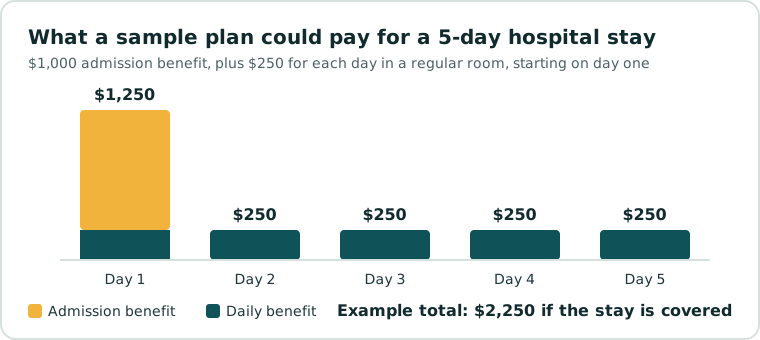
These are examples, not a promise: a plan pays only when the stay fits its rules and the claim is approved. See them in action in Marcus's, Priya's and Rosa's stories.
What does it cost?
In six 2026 employer plans we checked, it cost about $14 to $23 a month for just you, and $39 to $59 a month for your family.* Some employers pay part or all of it. Plans you buy on your own are priced by age and state.
What counts as a hospital stay?
Most plans pay only when you're officially admitted: a doctor admits you and you get a hospital bed.
These often don't count:
- An ER visit where you go home the same day.
- An observation stay. The hospital keeps you to watch you, sometimes overnight, without admitting you. Jordan learned this the hard way.
- A nursing home.
Tip: If you're kept overnight, ask: "Am I admitted, or here for observation?" The answer changes what both of your plans pay.
Confused already? You're not alone. Two plans can both be called "hospital indemnity" and pay very differently. A licensed insurance agent or broker in your state can read a plan's summary with you and explain what it would pay in your situation.
What it usually won't pay for
Every plan has a list of things it won't pay for. Common ones:
- Injuries from driving drunk, a crime, or risky hobbies like skydiving
- Cosmetic surgery
- Routine dental, vision and hearing care
- Anything without a hospital admission: doctor visits, outpatient surgery, scans or prescriptions
Does it work with an HSA?
Generally yes. A plan that pays a set amount per day in the hospital doesn't stop you from putting money in an HSA.*
Next: the fine print
The fine print is where plans differ: whether you can keep the plan and how soon it pays. Read hospital indemnity fine print.
Sources
* Not health insurance: federal regulators treat hospital indemnity as a way to replace lost income, not as comprehensive coverage. CMS fact sheet on fixed indemnity coverage.
* Cost: monthly hospital indemnity rates in six employers' 2026 benefits guides: Seminole County, FL, University of California, Murray State University, Great River Health, Oregon Health & Science University and HonorHealth. Per-paycheck rates converted to monthly.
* HSA: the IRS lists insurance paying "a fixed amount per day (or other period) of hospitalization" as allowed alongside an HSA. IRS Publication 969.