
Hannah and Luis did everything you're supposed to do. They planned to start a family, so during open enrollment they signed up for hospital indemnity insurance. Hannah remembers it costing just a couple of dollars a month. Most people end up in the hospital after a birth, she figured, so why not?
What they couldn't plan for was everything that came next.
This is a real family's story, shared with their own numbers. We've changed their names and filled in some everyday details. Every plan is different, and real payouts depend on the plan's rules and the insurer approving the claim.
Two heartbeats, and a hard road
It was twins, and the pregnancy was hard. Ella and Noah arrived early by C-section.
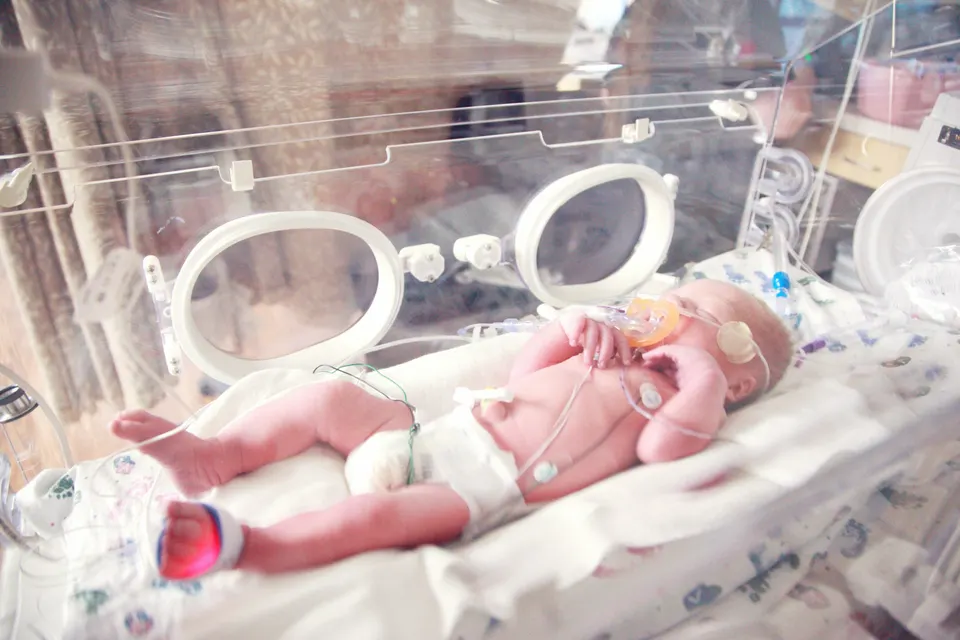
Babies born early often go to the NICU, the hospital's intensive care unit for newborns. They stay until they can breathe on their own, eat by mouth and stay warm.* For Ella, that took 34 days. For Noah, 52 days.
Hannah and Luis both stopped working, without pay, to be there.
What the plan paid
Then the hospital indemnity checks came in:
- $800 for Hannah's stay after her C-section
- $7,600 for Ella's 34 days in the NICU
- $11,200 for Noah's 52 days in the NICU
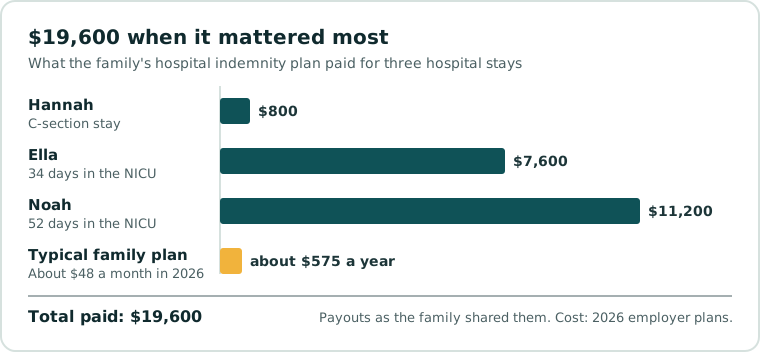
$19,600 in total. "For a benefit that was a couple of dollars a month," Hannah said. "This majorly helps offset our lost income."
The numbers fit a plan that pays $800 per admission plus $200 a day for each baby's own stay: $800 + 34 × $200 = $7,600, and $800 + 52 × $200 = $11,200.
What does a plan like this cost?
Hannah's cost was unusually low. Some employers pay part or all of the premium for you. In six 2026 employer plans we checked, family coverage cost $39 to $59 a month (about $48 on average), and coverage for just the employee cost $14 to $23 a month.* Most families will never have a stay like this one.
Why it paid so much
- They signed up before the pregnancy. Many plans won't pay for a pregnancy that began before coverage started. Maya's plan didn't pay for her birth for exactly that reason.
- The babies were on the plan. A plan only pays for a baby's own stay if the baby is covered. See how to add a newborn in time.
- NICU stays are long. Daily payments for weeks add up, just like Rosa's long stay.
What if… their plan stopped daily payments after 30 days a year, as some do? Noah's 52-day stay would have paid for only 30 of those days. Limits like that are easy to miss. A licensed agent or broker in your state can walk you through a plan's day limits and newborn rules before you need them.
Who would have thought?
"Obviously none of us hope for complications or that we have to spend time in the NICU," Hannah said, "but you never know how your pregnancy is going to go."
Nobody signs up expecting 86 days of NICU stays between two babies. But because they'd signed up months earlier, this family had something coming in when two paychecks stopped.
If you're planning a family, read the fine print on waiting periods, and check how your plan treats pregnancy and newborns before you need it.
Sources
* NICU care: MedlinePlus explains that babies born early get special nursery care until they can breathe without extra support, eat by mouth and keep their body temperature and weight. MedlinePlus: premature infant and visiting your baby in the NICU.
* Cost: monthly hospital indemnity rates in six employers' 2026 benefits guides: Seminole County, FL, University of California, Murray State University, Great River Health, Oregon Health & Science University and HonorHealth. Per-paycheck rates converted to monthly.
The family's payouts are as they shared them; the $800 and $200 amounts are our reading of how those totals add up. Adding a baby to a Marketplace health plan: HealthCare.gov.