
Health insurance has its own vocabulary, and it decides how much you pay every time you see a doctor or fill a prescription. Once you know five terms, you can read any plan.
The five numbers that decide what you pay
Premium
The premium is your monthly payment to keep the plan, whether or not you use any care. If your employer offers coverage, it's usually taken from your paycheck (and if you leave that job, see COBRA vs. a Marketplace plan). If you buy your own plan, a premium tax credit may lower it: see ACA open enrollment.
Deductible
The deductible is what you pay for covered care each plan year before the plan starts sharing costs. With a $2,500 deductible, you pay the first $2,500 of covered bills yourself. Some high-deductible plans let you save for those costs tax-free in a health savings account.
Two important exceptions: ACA-compliant plans cover preventive care (annual checkups, many screenings and vaccines) at no cost in-network, even before you meet your deductible (HealthCare.gov: preventive care benefits), and many plans let you pay a simple copay for office visits or generic drugs before the deductible is met.
Copay
A copay is a flat amount for a specific service, such as $30 for a primary care visit or $15 for a generic prescription.
Coinsurance
Coinsurance is your percentage of the bill after the deductible. With 20% coinsurance, on a $1,000 covered bill you pay $200 and the plan pays $800.
Out-of-pocket maximum
The out-of-pocket maximum is your safety net: the most you'll pay in a plan year for covered, in-network care. Deductibles, copays and coinsurance all count toward it. Premiums don't. If reaching it would strain your budget, it's worth understanding what supplemental health insurance does and doesn't pay.
Following one bill from start to finish
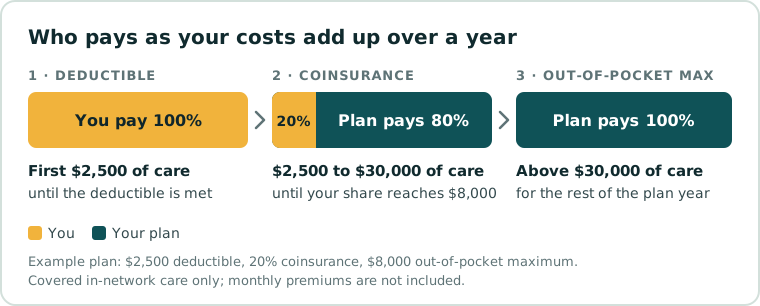
Say your plan has a $2,500 deductible, 20% coinsurance and an $8,000 out-of-pocket maximum. In March you have outpatient surgery with an allowed amount of $10,000, and you haven't paid anything toward your deductible yet.
| Step | You pay | Plan pays |
|---|---|---|
| First $2,500 (deductible) | $2,500 | $0 |
| Remaining $7,500 at 20% coinsurance | $1,500 | $6,000 |
| Total | $4,000 | $6,000 |
You've now paid $4,000 toward your $8,000 out-of-pocket maximum. If you need more care later in the year, once your share reaches $8,000, the plan covers the rest at 100%.
Networks change everything
These numbers usually apply only to in-network providers, the doctors and hospitals that have contracts with your plan. Out-of-network care may cost much more or not be covered at all, depending on whether you have an HMO, PPO or EPO. See HMO vs. PPO vs. EPO. One important safety net: the No Surprises Act protects you from most surprise out-of-network bills for emergency care and for some care at in-network hospitals (CMS: your rights against surprise medical bills).
Where to find your plan's numbers
Insurance companies and job-based plans must give you a Summary of Benefits and Coverage (SBC), a short, plain-language document that lists the deductible, out-of-pocket limit, copays and coinsurance, so you can make apples-to-apples comparisons (HealthCare.gov: the SBC). When comparing plans, put their SBCs side by side.
What to do next
- Find your plan's SBC and locate your deductible and out-of-pocket maximum.
- Look up any term you don't recognize in the glossary.
- Buying your own coverage? Check the dates in ACA open enrollment.
- Learn to check your bills with how to read an explanation of benefits.