Nobody packs a hospital bag for the week after the baby comes home. This is the story of a stay nobody plans for, and how hospital indemnity insurance helped when it happened.
It's based on a real story a mother shared. We've changed her name to Maya and filled in some everyday details. Real payouts depend on each plan's rules and on the insurer approving the claim.
A plan that didn't cover the birth
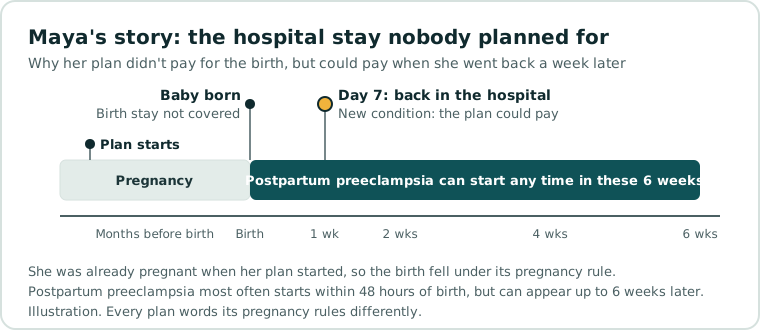
Maya signed up for hospital indemnity when she was already a few months pregnant. She knew the catch: her plan wouldn't pay for a pregnancy that began before her coverage started.*
So when her daughter was born, the birth stay paid nothing. That's the pre-existing condition rule at work, and Maya had made peace with it. The baby was healthy. They went home.
Seven days later
Then, a week after the birth, Maya woke up with a headache that wouldn't quit. By the afternoon her face and hands were puffy, and the light hurt her eyes. She thought it was the exhaustion every new parent talks about.
Her partner didn't. He drove her to the ER with the baby in the back seat. Her blood pressure was dangerously high. The doctors called it postpartum preeclampsia and admitted her for 3 days.
Who would have thought? The pregnancy was over. The baby was fine. And yet here she was, back in a hospital bed, with a newborn at home.
What is postpartum preeclampsia?
It's high blood pressure after giving birth, with signs that organs like the liver or kidneys are under strain. It most often starts within 48 hours of birth, but it can appear up to 6 weeks later, often after you're home.* It can be life-threatening, which is why fast care matters.
Warning signs to take seriously after a baby:*
- A headache that won't go away or gets worse
- Changes in your vision, like spots or blurriness
- Extreme swelling of your hands or face
- Trouble breathing, or chest pain
- Severe nausea and throwing up, or belly pain that doesn't go away
If you notice these, get medical care right away and say you recently had a baby. This article isn't medical advice; your doctor is the right person to talk to about your risk.
How hospital indemnity helped
This time, Maya's plan treated the stay as a new hospital admission, not part of a pregnancy that started before her coverage. So it paid.
With a sample plan paying $1,000 when admitted and $250 a day, a 3-day stay could pay:
- $1,000 + 3 days × $250 = $1,750
It wasn't a fortune. But it arrived as cash, in Maya's name, at the moment her family needed it most: her partner had used up his leave, and the hospital bills were already coming. In her own words: "Obviously I couldn't have predicted that that would happen to me but it really worked out and helped pay for my hospital bills."
What if… Maya's plan had counted any pregnancy problem as part of the original pregnancy? Some plans word it that way, and it might have paid nothing. That's the kind of detail that's hard to spot on your own. A licensed agent or broker in your state can show you how a plan handles pregnancy, before the due date and not after.
What Maya's story teaches
- The unexpected is the point. Hospital indemnity earns its keep when something you didn't plan for happens.
- A "no" for one stay isn't a "no" for every stay. A plan that won't pay for a birth may still pay for a new problem afterward.
- Read the pregnancy wording. See hospital indemnity and having a baby.
For more stories, see Priya's C-section and two others and two times the plan paid little or nothing.
Sources
* Pregnancy rule: many plans won't pay for a pregnancy that began before coverage. Check your outline of coverage.
* Timing and definition: postpartum preeclampsia most often occurs within 48 hours of delivery, with risk continuing up to 6 weeks. MedlinePlus (National Library of Medicine).
* Warning signs: from the CDC's urgent maternal warning signs, which apply during pregnancy and in the year after delivery. CDC Hear Her campaign. More background: Preeclampsia Foundation.